
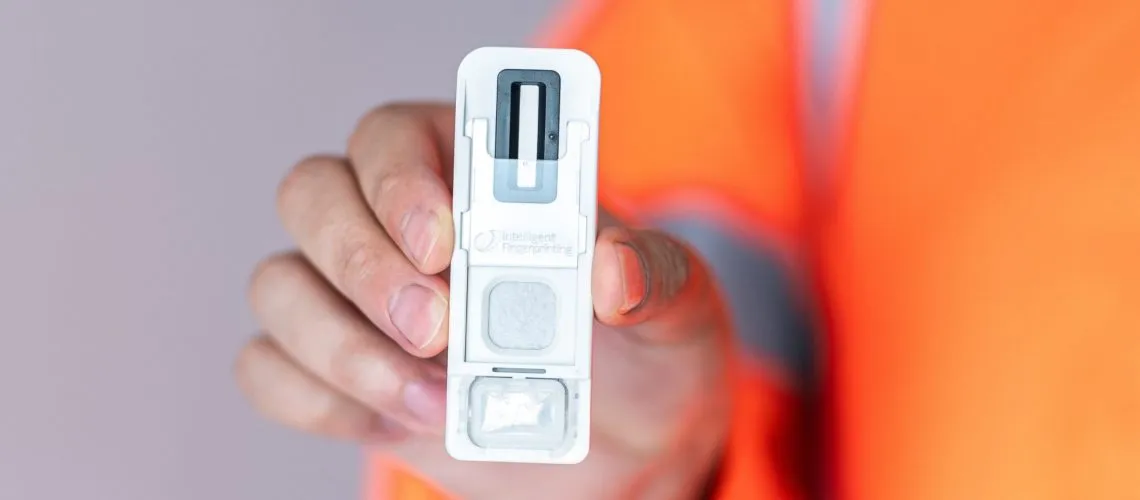
Fingerprint drug testing screens for recent drug use using sweat from the fingertips. The person presses all ten fingertips onto a cartridge, a portable reader analyses it, and the result appears on screen in about 10 minutes. This guide is for UK employers who want to understand how it works, what it detects and where it fits, and it links to our more detailed guides.
Watch our video: Fingerprint Drug Testing Explained
What Is Fingerprint Drug Testing?
Fingerprint drug testing analyses sweat residue left by the fingertips to detect drug metabolites. It does not need urine, saliva or any other bodily fluid, so it is cleaner, quicker and more discreet than traditional methods. It is designed to detect recent drug use, which makes it well suited to checking whether someone is fit for work now.
How It Works
- Sample Collection: The person presses all ten fingertips onto a specialised cartridge. It takes seconds and needs no laboratory facilities or special preparation.
- Analysis: The cartridge goes into a portable reader, which uses a fluorescent immunoassay to screen for drug metabolites.
- Result: Within about 10 minutes, the reader shows the result on screen.
If a result is non-negative, a further sample can be sent to a laboratory for confirmation. For a closer look at each stage, read our step-by-step guide to how a sweat-based drug test works.
What It Detects
The screening test covers four main drug groups: cocaine, opiates, methamphetamine and cannabis. Laboratory confirmation can identify a wider range of substances. The test typically picks up use within the last 16 to 24 hours, and the time varies by substance. Our guide to fingerprint drug test detection times explains the detail.
Benefits for Employers
- Non-Invasive and Dignified: no urine or saliva sample is needed, which protects privacy and is easier for everyone involved.
- Quick: results in about 10 minutes, so decisions can be made on the spot.
- Hygienic: no bodily fluids means no biohazard handling or clinical waste.
- Secure: tamper-evident cartridges and a supervised process make interference very difficult.
- Portable: testing can take place on site, with no specialist facilities.
Where Employers Use It
Fingerprint drug testing is used in safety-critical industries such as construction and transportation, where a drug-free workplace matters most. Typical uses are:
- Pre-Employment Screening, to check new starters before they begin work.
- Random Testing, to deter drug use.
- Post-Incident Testing, to see quickly whether impairment may have played a part.
It is also used in other settings, including treatment and social care services. Read more about how it is used in transportation and construction.
How It Compares With Urine and Saliva Tests
Urine and saliva tests can feel intrusive, often need a private collection area and clinical waste disposal, and may involve waiting for laboratory results. A fingerprint test removes most of that: there is nothing to collect except the fingertip sample, and the result is available straight away. As with any screening test, non-negative results are confirmed by laboratory analysis. Our guide to biometric screening and drug testing explains how drug testing differs from a health screening.
Things to Consider
- Recent Use Only: the test is designed to show recent use. It does not show historical use the way hair testing can.
- Range of Substances: the screening panel covers four main drug groups.
- Equipment and Training: readers and training are an upfront investment. See what affects the cost.
- A Clear Policy: tell your people what is tested, when and why. Our guide to workplace drug testing covers this.
More Guides
- How a Sweat-Based Fingerprint Drug Test Works, Step by Step
- Fingerprint Drug Test Detection Times
- Fingerprint Drug Testing Cost: What Affects the Price
- The Intelligent Fingerprinting Drug Screening System Explained
- Does Biometric Screening Include Drug Testing? A UK Guide
- HS2 Inductions at Our Birmingham Training Centre